
.webp)
HelpGhost Scholar: The Guide to MSP Documentation Automation
Stop wasting time on manual docs. Use HelpGhost's knowledge centralization and automation software, Scholar, to capture tribal knowledge and scale your team.
HelpGhost Scholar: The Guide to MSP Documentation Automation
Every MSP reaches the same breaking point: senior engineers are bogged down by repetitive pings while high-value tickets age. This is the result of documentation debt. By implementing MSP documentation automation, MSPs can transition from a reliance on tribal knowledge to a scalable, system-driven model.
According to the IT Glue Global Documentation Survey, the average MSP technician wastes 20% of their time—roughly 8 hours every week—searching for information that isn't properly documented. This 'documentation tax' is highest for senior engineers, who are constantly pulled away from high-value projects to act as human search engines for junior staff.

Manual docs carry a fundamental flaw: they're outdated the moment they're saved. Environments change, vendors push updates, clients add complexity — and no one has time to revise the KB. The result is a growing gap between what's documented and what's actually true, forcing technicians to rely on tribal knowledge that walks out the door whenever someone resigns.
This is the documentation debt cycle. Tickets take priority. Notes get skipped. Institutional knowledge concentrates in a handful of senior people who become irreplaceable bottlenecks — and manual documentation overhead already costs technicians an estimated 2 to 5 hours per week, time that could be closing tickets instead.
HelpGhost’s knowledge centralization and automation tool, Scholar, exists precisely to break this cycle. But understanding why it matters at a strategic level — not just an operational one — means looking closely at what intelligent automation actually does to the value of expertise itself.
The Strategic Impact of HelpGhost Scholar Knowledge Centralization and Automation
The previous section laid out the cost of documentation debt — the endless cycle of tribal knowledge hoarding and repeated escalations. But understanding the problem is only half the equation. The other half is recognizing what a structural solution actually looks like, and why the timing has never been better to act on it.
Intelligent Automation (IA) in a service desk context means more than running scripts or auto-closing tickets. It refers to systems that capture, organize, and surface institutional knowledge without requiring a human to manually curate every entry. Where traditional automation handles repetitive tasks, IA handles repetitive thinking — the pattern recognition that senior technicians apply almost unconsciously when diagnosing an issue.
The Shift in Labor Value
"Intelligent Automation transforms service work by shifting the burden of knowledge retrieval from human memory to automated systems." — Journal of Strategic Information Systems
This shift redefines what your team's labor is actually worth. When a junior technician no longer needs a senior engineer on speed dial to resolve a known issue, your senior staff stop being a lookup service. Their value moves upstream — toward system improvement, client strategy, and proactive problem management. That's a fundamental change in how an MSP scales.
From a workforce standpoint, technicians who focus on high-value problem-solving rather than repetitive manual tasks report higher job satisfaction; research shows that nearly 60% of workers feel hindered by 'low-brain-power' activities that drive burnout (UiPath, 2021).
From an Operations standpoint, faster resolutions driven by automated knowledge access translate to measurable efficiency gains across service teams, which is exactly where the best HelpGhost Scholar knowledge centralization and automation tools prove their ROI most clearly.
The question, then, isn't whether automation can replace tribal knowledge — it's how that extraction actually happens at scale. That's precisely where HelpGhost Scholar enters the picture.
HelpGhost Scholar: Automating the Extraction of Tribal Knowledge
Strategy only matters when the mechanics actually work. That's where HelpGhost’s knowledge centralization and automation software moves from concept to competitive advantage.
Mining the Tickets You Already Have
Every PSA tool sitting in your stack is a goldmine of undocumented institutional knowledge — and most MSPs never tap it. HelpGhost Scholar changes that by automatically scraping ticket histories and PSA entries to identify the tribal knowledge that has historically existed nowhere else but in the heads of your techs.
This isn't keyword search dressed up in a lab coat. Scholar analyzes how issues were actually resolved — finding "the real way" things get fixed, not the sanitized version someone might eventually type into a Word doc. Automated extraction captures significantly more institutional knowledge than traditional manual documentation methods. That's not a marginal improvement. That's a fundamentally different knowledge baseline.
Client-Tenanted Knowledge: Secure by Design
One legitimate concern MSPs raise around centralized knowledge is data segregation. Scholar addresses this through client-tenanted knowledge architecture, meaning each client's data is stored, accessed, and surfaced within its own secure context. A technician working on one client's environment doesn't inadvertently pull procedures or credentials from another. Security and accessibility aren't trade-offs here — they're both delivered.
Closing the Seniority Gap
Perhaps the most tangible outcome is what this means for your team.
We can essentially make all of our Level 1s almost Level 3 equivalents. HelpGhost takes junior techs and helps them become more like one of our senior techs." — Steve T., MSP Owner via HelpGhost.
When a junior technician gets a real-time, contextually relevant resolution pulled from hundreds of historical tickets, they stop guessing. They execute with confidence.
The HelpGhost Knowledge Centralization and Automation Guide: Moving from Ticket Data to Captured Knowledge
Knowing what HelpGhost Scholar does is one thing. Getting it operational — and keeping it that way — is where most teams stumble. A practical HelpGhost Scholar knowledge centralization and automation guide starts with one honest admission: you can't automate what you haven't assessed.
Scale: Adoption Without Adding Friction
Technicians won't adopt any system that treats documentation as extra homework. The advantage of automated extraction is that adoption happens with less friction than traditional knowledge base implementation. Knowledge distribution stays balanced across the entire software stack because the system ingests from every ticket, not just the ones someone remembered to document.
But how does this approach stack up against the broader field of knowledge management tools available heading into 2026?
The 2026 Landscape: Comparing Knowledge Management Software
MSP documentation has entered a new era — and the tools that defined the last decade are struggling to keep up. Traditional documentation platforms built around manual entry and keyword search were designed for a slower, simpler IT environment. That world no longer exists.
The distinction worth drawing isn't just about features. It's about philosophy.
Tool Category | Primary Method | Documentation Burden |
|---|---|---|
Traditional KBs | Manual authoring, keyword search | High — engineers write everything |
AI-Assisted Editors | Autocomplete + templates | Medium — still requires human input |
Automation-First Platforms | Ticket pattern extraction + auto-generation | Low — system learns from existing work |
Traditional platforms are powerful organizational tools, but they operate on an assumption that doesn't hold in most MSPs: that someone will actually sit down and write the documentation. In practice, that rarely happens under real operational pressure.
Why Search Isn't Enough Anymore
"Search" assumes the technician knows what to look for. Proactive retrieval delivers the right knowledge before the question is even fully formed. As modern knowledge management moves toward composable architecture and real-time retrieval (RAG), the gap between passive documentation libraries and active intelligence layers widens considerably.
The real bottleneck isn't finding documentation — it's that the documentation was never created in the first place.
Knowledge Graphs and Distributed IT
In distributed IT environments managing dozens of client stacks, knowledge graphs provide something flat KBs can't: relational context. They map how systems, issues, and resolutions connect — so a fix applied in one environment surfaces intelligently when a similar pattern emerges elsewhere. AIOps platforms are already demonstrating this capability at the infrastructure level.
The convergence of automation-first documentation, proactive retrieval, and graph-based context isn't a future concept. It's actively reshaping what MSPs can realistically expect from their knowledge stack — which raises a question every team leader will need to answer soon: build smarter, or keep hiring bigger?
Conclusion: Future-Proofing Your MSP with Automated Intelligence
The choice every MSP owner faces eventually isn't really about software — it's about strategy. Do you keep hiring expensive senior engineers to carry tribal knowledge in their heads, or do you invest in making every technician on your team dramatically more efficient? The math increasingly favors the latter. McKinsey Global Institute research shows that implementing robust centralized knowledge leads to a significant reduction in search time — time your team currently spends hunting for answers that already exist somewhere in your ticket history.
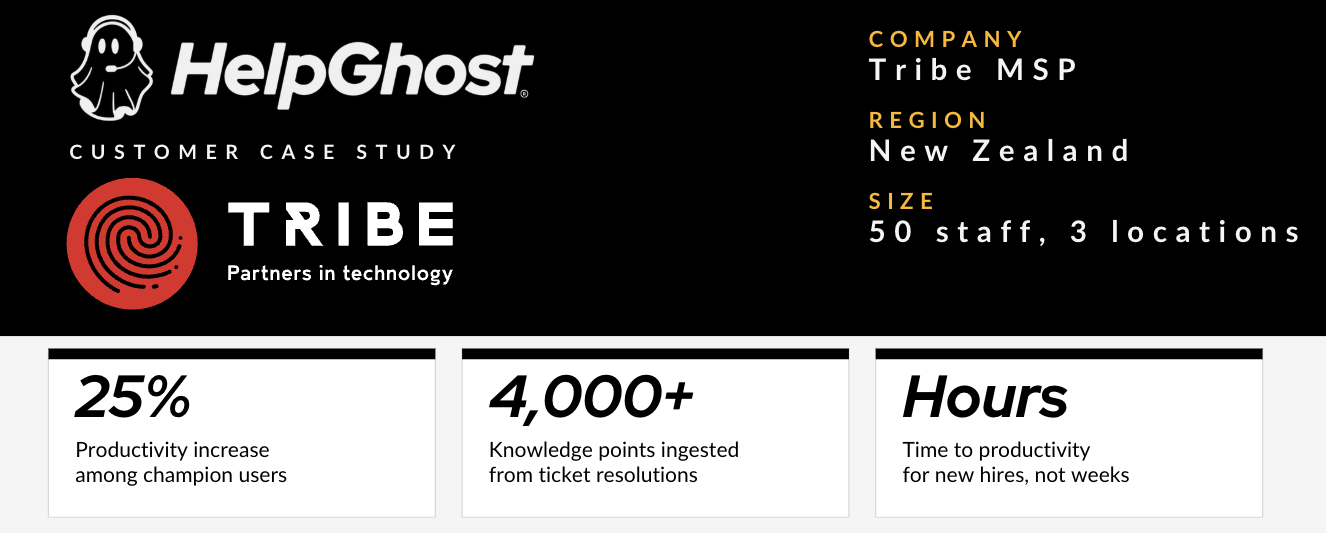
Automated tribal knowledge extraction is the mechanism that closes this gap permanently. Rather than watching hard-won institutional expertise walk out the door with every resignation, you're building a compounding knowledge asset that grows more valuable with each resolved ticket. In practice, the MSPs that thrive over the next five years won't necessarily be the ones with the largest headcount — they'll be the ones with the most intelligent systems. As AI governance concerns continue to shape the industry, owning and controlling your own knowledge infrastructure becomes a genuine competitive advantage.
The window to act is open now, before your competitors realize the same thing.
Success Metric: MSPs using automated knowledge systems report faster onboarding, reduced escalations, and measurable technician confidence gains within the first 90 days of deployment.
Ready to stop losing senior expertise every time someone quits? Start automating your tribal knowledge with HelpGhost Scholar today →